
The risk of a residential fire, as well as the risk of injury and death from fire, is greater in certain population groups.
These "at-risk groups" are comprised of "individuals unable to receive, understand, or act on information prior to or during an actual emergency" (Australasian Fire and Emergency Services Authorities Council, 2009).
At-risk groups include:
- older people
- the very young (aged 0-4)
- people with disabilities
- People in homes affected by hoarding
- People in homes with no working smoke alarm
- people who experience social and financial disadvantage
- People who smoke.
For these individuals, fire risk may be one component in a broader range of risks which impact their safety, health, and wellbeing. Due to demographic and social factors, at-risk groups represent a growing proportion of the population in Victoria.
To report residential fire safety risks or for more information on how At-Risk Groups Unit may be able to help you, please do not hesitate to complete the form below. At Risk Groups role is to assess risk and provide fire prevention and fire risk mitigation advice and support for disadvantaged communities.
Submit an enquiry
Complete the referral form to submit an enquiry to the FRV At Risk Groups Unit.
FAQs
- Individuals affected by hoarding, or family members
- carers or support workers (home care, disability, mental health, or aged care services)
- health and allied health professionals (e.g. GPs, nurses, occupational therapists, social workers)
- housing or tenancy workers
- municipal council employees
To complete a fire safety referral form, click here.
The information collected in this form is used by Fire Rescue Victoria to provide an ‘advanced notice' to fire crews when responding to emergencies at the property.
The information that you provide around additional fire safety risks will help us increase operational preparedness for attending crews and allow FRV At Risk Groups to provide targeted risk reduction advice.
Fire Rescue Victoria collects the information that you provide with this referral/enquiry form. The information that you provide is used to respond to your enquiry.
FRV is bound by the Privacy and Data Protection Act 2014 (Vic) and is required to adhere to the Information Privacy Principles which set out the minimum standards for the handling of personal information in the Victorian public sector.
FRV is committed to protecting your privacy and will collect, hold, use and disclose your personal information accordingly.
You can request access to, and corrections of, any personal information provided in this form. Requests for access or correction should be sent to FRV's Privacy team via email.
Yes, in most cases you should gain consent from the resident before making a referral to FRV.
Making a referral without the consent of the resident limits the potential actions that FRV can take to reduce the risk.
There may be some situations where it is not possible to gain consent, including reporting hoarding risks.
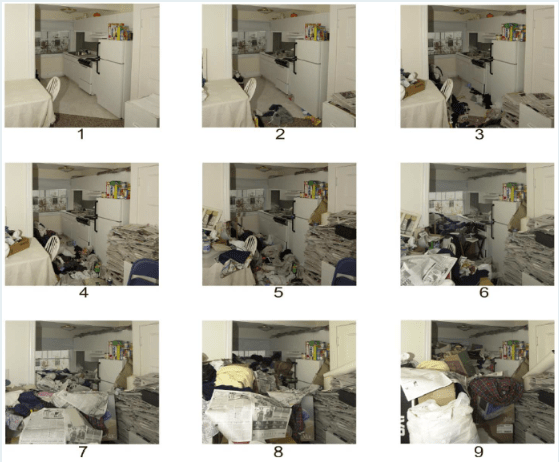
You should refer hoarding/clutter if the home has doorways and paths of exit that are blocked or significantly obstructed, if there are unmanaged health or fire safety risks or if the hoarding is estimated to be at level 5 or above on the Clutter Image Rating Scale.
You can view the Clutter Image Rating Scale below:
Hoarding and excessive clutter significantly increases fire risk and danger to both occupants and firefighters and can result in:
- Increased fire load: Large amounts of stored items provide abundant fuel, causing fires to start more easily, burn faster, and become more intense.
- Blocked exits and escape paths: Clutter can prevent occupants from safely evacuating during a fire, increasing the risk of injury or death.
- Delayed firefighting operations: Hoarded materials can block access for firefighters, slow fire suppression, and make search-and-rescue operations more difficult.
- Hidden ignition sources: Electrical faults, heaters, candles, or cooking hazards may be concealed by clutter, increasing the likelihood of an undetected fire starting.
- Structural instability: Excessive weight from hoarded items can weaken floors or stairs and increase the risk of collapse during a fire.
- Higher risk to vulnerable people and animals: Hoarding environments often involve people with limited mobility, health issues, or pets who may be unable to escape quickly.
Hoarding and clutter can turn otherwise survivable fires into life-threatening emergencies and places firefighters at greater risk when responding.
If you would like to make a referral, click here.
Even if your Carer or Support Worker knows your circumstances, they may not have submitted a referral themselves. Awareness by support staff does not replace the referral process. Completing the form helps ensure you receive the right level of fire safety support and protection.
You can report any issues with building false alarms via False alarms.
You can report commercial property compliance issues via Report a fire safety issue.
You can refer a child or young person Fire-CAP program via Firelighting Consequence Awareness Program (Fire-CAP)(opens in a new window).
Contact us
In an emergency call Triple Zero (000) for fire and rescue, police, or ambulance assistance.
Updated